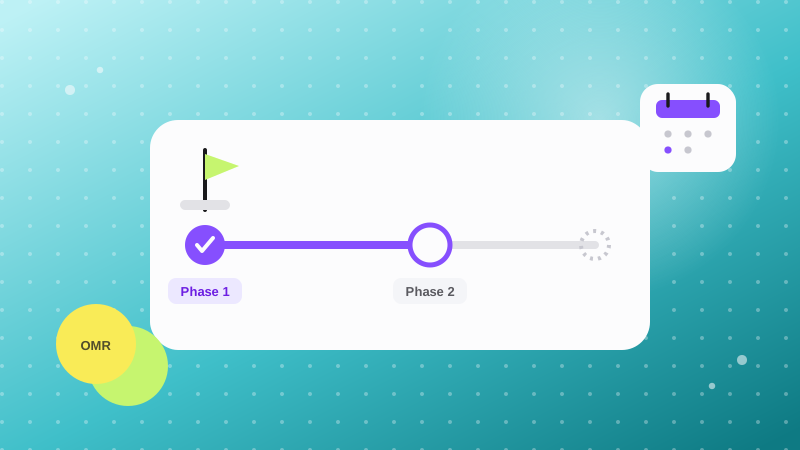
If you only need one answer from this page, here it is: Oman's Fawtara e-invoicing mandate has two phases, and which one applies to you comes down to a single number — your annual taxable turnover.
For the full legal background (the decision that created this mandate, the network model behind it, the required format), see our complete Fawtara guide. This page is just the "which date is mine" version.
The two phases
Under Tax Authority Decision No. 189/2026 (published in Official Gazette No. 1660, 9 August 2026), the mandate rolls out in two stages:
| Phase | Effective date | Who it applies to |
|---|---|---|
| Phase 1 | 1 April 2027 | Annual taxable supplies above OMR 5 million |
| Phase 2 | 1 October 2027 | Annual taxable supplies below OMR 5 million |
That's it — there isn't a third phase or an earlier pilot date you need to plan around. If you've seen an "August 2026" date mentioned elsewhere as a rollout milestone, that's when the decision itself was published, not a separate phase businesses move through.
The self-check
Ask yourself one question: does my business's annual taxable turnover exceed OMR 5 million?
- Yes → you're Phase 1. Your deadline is 1 April 2027.
- No → you're Phase 2. Your deadline is 1 October 2027.
That's the entire test. It's based on turnover, not industry, company size in headcount, or how long you've been registered for VAT. A small headcount business with high-value transactions can land in Phase 1; a larger business with lower per-transaction turnover can land in Phase 2.
If your turnover sits close to the OMR 5 million line and could plausibly move either side of it before 2027, the safer planning assumption is to prepare as if you're Phase 1 — being ready early costs you nothing, being unready at your actual deadline does.
What happens if you miss your date
We're deliberately not putting a specific penalty figure here — OTA hasn't published a detailed penalty schedule as of this writing, and guessing at a number would be exactly the kind of unconfirmed claim we're trying to avoid across this whole guide. What we can say plainly: once your phase's date passes, e-invoicing through the Peppol/PINT-OM network stops being optional for your business, so continuing to issue invoices the old way after your date is a compliance gap, not a grace period. See our dedicated guide on non-compliance risk for what we do know, and treat anything you read elsewhere with a specific fine amount as unconfirmed until it's traceable to OTA directly.
How to prepare, phase by phase
If you're Phase 1 (1 April 2027):
- Start now — a compliant setup involves both a Peppol connection and correct PINT-OM XML generation, and that's not a same-week integration.
- Confirm your provider (or in-house build) actually produces PINT-OM output, not generic UBL — see our PINT-OM explainer for the difference.
- Test well before the deadline, not in the weeks immediately before it.
If you're Phase 2 (1 October 2027):
- You have more runway, but "more time" isn't the same as "no rush" — Phase 1 businesses will be competing for the same accredited-provider capacity in early 2027, so waiting until mid-2027 to start narrows your options.
- Use the extra months to actually compare providers properly — see our guide to choosing an e-invoicing provider in Oman once it's live.
- If your turnover is trending upward, re-check the OMR 5 million threshold periodically — you don't want to discover in early 2027 that you've quietly become Phase 1.
For SME-specific guidance beyond this quick check, see our Phase 2 survival guide for SMEs.
Unfamiliar term? Check our Oman e-invoicing glossary.
Sources: Tax Authority Decision No. 189/2026, Official Gazette No. 1660 (9 August 2026). Dates match our complete Fawtara guide exactly.