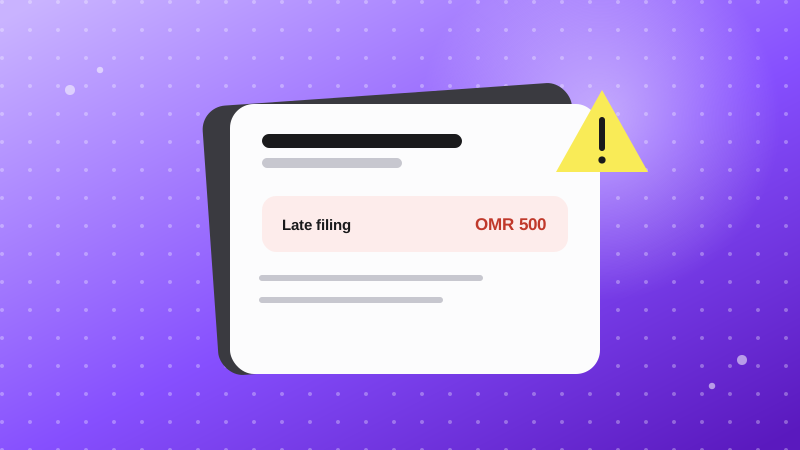
Once your Fawtara phase date passes, e-invoicing stops being a "when we get to it" project. Here's what non-compliance actually means, and what it costs.
What counts as non-compliance
In practical terms, once your phase applies to you, non-compliance includes:
- Not issuing invoices as compliant PINT-OM documents through the Peppol network (see our format explainer for what "compliant" actually means).
- Not submitting the required Tax Data Document to OTA for a transaction — a separate obligation from delivering the invoice itself, as we cover in our complete Fawtara guide.
- Not retaining invoice records for the required period (10 years generally, 15 for real estate, under Article 70 of Royal Decree 121/2020).
- Continuing to issue only paper or unstructured-PDF invoices past your phase's effective date.
The penalty framework
Here's an important distinction: Tax Authority Decision No. 189/2026 — the decision that created the e-invoicing mandate — doesn't set its own penalty amounts. It creates the obligation; enforcement runs through the existing VAT penalty framework that already applies to invoicing failures generally.
Based on published legal analysis of that framework (not yet independently cross-checked against OTA's own guidance — treat these figures as reported, not confirmed, and verify directly with OTA or a tax advisor before relying on them):
- Article 202 of the VAT Law's Executive Regulations reportedly covers general non-compliance, with fines cited in the OMR 500 to OMR 5,000 range per infraction, and potential business suspension for serious or repeated violations.
- Article 100 of the VAT Law reportedly covers deliberately refusing to issue a required tax invoice specifically — cited penalties include imprisonment of two months to one year, a fine of OMR 1,000 to OMR 10,000, or either.
We're deliberately citing these as "reported" rather than stating them as settled fact — OTA hasn't published a Fawtara-specific penalty schedule as of this writing, and this guide won't put a number in front of you that we can't trace to the primary source ourselves. Confirm the current figures with OTA directly, or a licensed tax advisor, before treating any specific amount as your actual exposure.
The business risk beyond the fine
A fine is the visible cost. The less visible ones matter more for most businesses:
- Your own compliance record has a gap the day your phase date passes if you're not issuing compliant invoices — this isn't a grace period, it's exposure that accrues from day one.
- Buyers on the Peppol network may not be able to process your invoices at all if they're not delivered in the correct format — that's a cash-flow problem (delayed payment) before it's ever a fines problem.
- Retroactive fixes are harder than getting it right the first time. Re-issuing historical invoices in the correct format, after the fact, once you notice a gap, is real operational work you don't control the timing of.
How to get ahead of it
- Confirm your phase date now — see our self-check.
- Don't wait until the month before your deadline to start; accredited providers and Access Points have limited onboarding capacity as everyone's deadline converges.
- Verify your provider (or in-house build) actually produces compliant PINT-OM output before you're relying on it — see our OTA-accredited service provider guide for how to check.
- If you're a smaller business on the Phase 2 date, see our Phase 2 survival guide for SMEs for a realistic, non-enterprise-scale prep plan.
Unfamiliar term? Check our Oman e-invoicing glossary.
Sources: Tax Authority Decision No. 189/2026; Royal Decree No. 121/2020 (VAT Law), Article 70. Penalty figures per Articles 100 and 202 are cited from published legal analysis of the VAT Law and its Executive Regulations, not yet independently confirmed against OTA's own guidance — verify directly before relying on them.